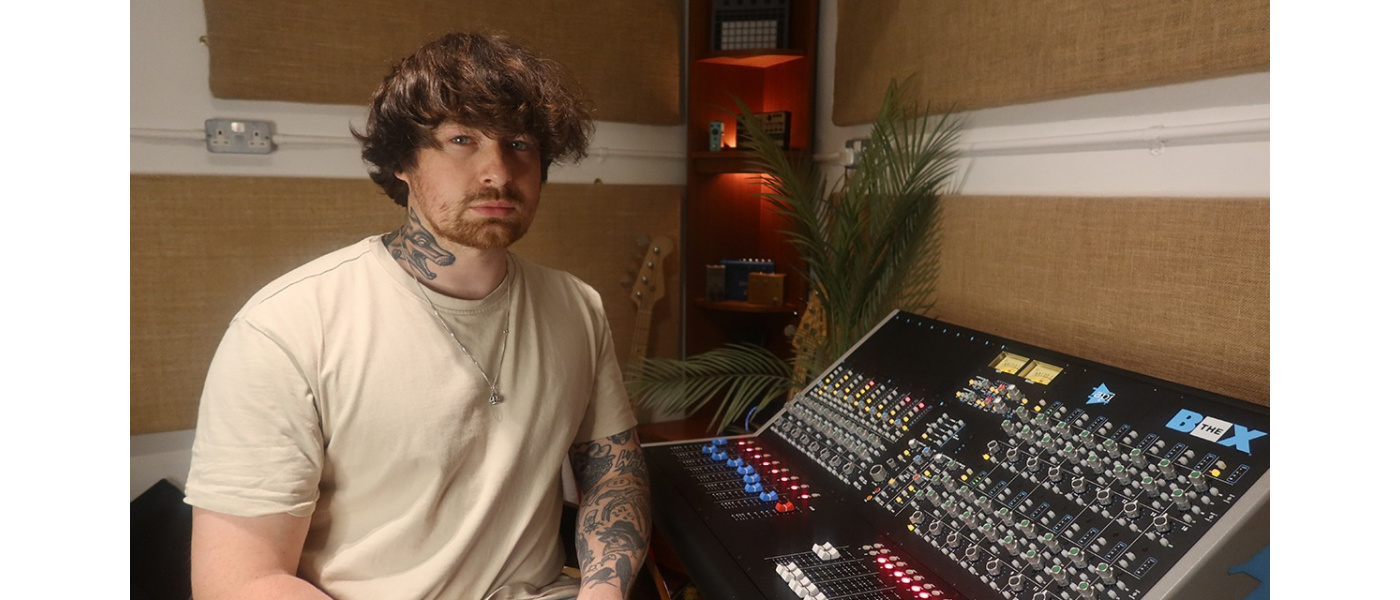
“It’s next to impossible … to botch recording any source with AUDIX in general!”
Tayte Nickols is one of the most sought-after producers for emerging musical artists in the U.K. and around the world. His early forays into recording and production included an internship at Catalyst Studios where he would learn the Pro Tools platform. By age 23, he would become one of the youngest commercial studio owners in England with the opening of Mad Fox in Manchester. Most recently, he was honored with Breakthrough Producer of the Year recognition by the Music Producers Guild — a British analogue of the U.S.-based Recording Academy’s Producers and Engineers wing. His preferred microphones for nearly all applications are from AUDIX, including the multi-mic on drums; the on piano, overhead duties, and other acoustic sources; and the A133 large-diaphragm condenser on vocals and acoustic guitar. Despite his time being impossibly in demand, he spoke with AUDIX about his career so far, overcoming dyslexia, and his use of our mics in his recording process.
Describe your early journey to becoming a producer.
In school I had this one friend who was obsessed with The Beatles. I started listening to them, and it was the first time I started really listening to music actively. Then my friend started learning Beatles songs on guitar, and I decided to learn bass because I thought it was easier. I had already asked for a bass for my birthday. Then I got into guitar and piano, and became intrigued with learning as many instruments as I could and playing any song I could get my hands on. Not long after, I fell into recording myself.
I joined a band while I was at university, and though our music wasn’t very good, we worked with some good producers who seemed to turn rubbish songs into something really enjoyable. I thought to myself, “I want to start doing that, because it looks fun.” I took out a small loan and set up a recording studio, and just started blindly producing songs and bands.
Over time I suppose I got better and better at it. I eventually liquidated my studio and moved to London, where I started using larger spaces like Abbey Road and Metropolis.
Given that the Music Producers Guild named you Breakthrough Producer of 2024, it seems you made the right choice.
Yeah, I won that in the earlier part of this year. It was so nice to be recognized for my work. All I really do is find bands that are up-and-coming, grassroots, talented but perhaps not doing much, and I try to develop them. That was lovely.
What are you working on and excited about right now?
I’m taking a bit of a sabbatical, in fact, because we’re working on building a studio in the Lake District [Cumbria]. I just had some fun sessions with the singer Dana Luna, and there’s a new artist Lissy Taylor. We’re waiting for the mixes to come back on a new track of hers and I’m excited. I also just worked with a band called Body of Water, and we put their drum kit in a large barn and did a full record in there. That was fun!
When and where did AUDIX microphones come into the picture?
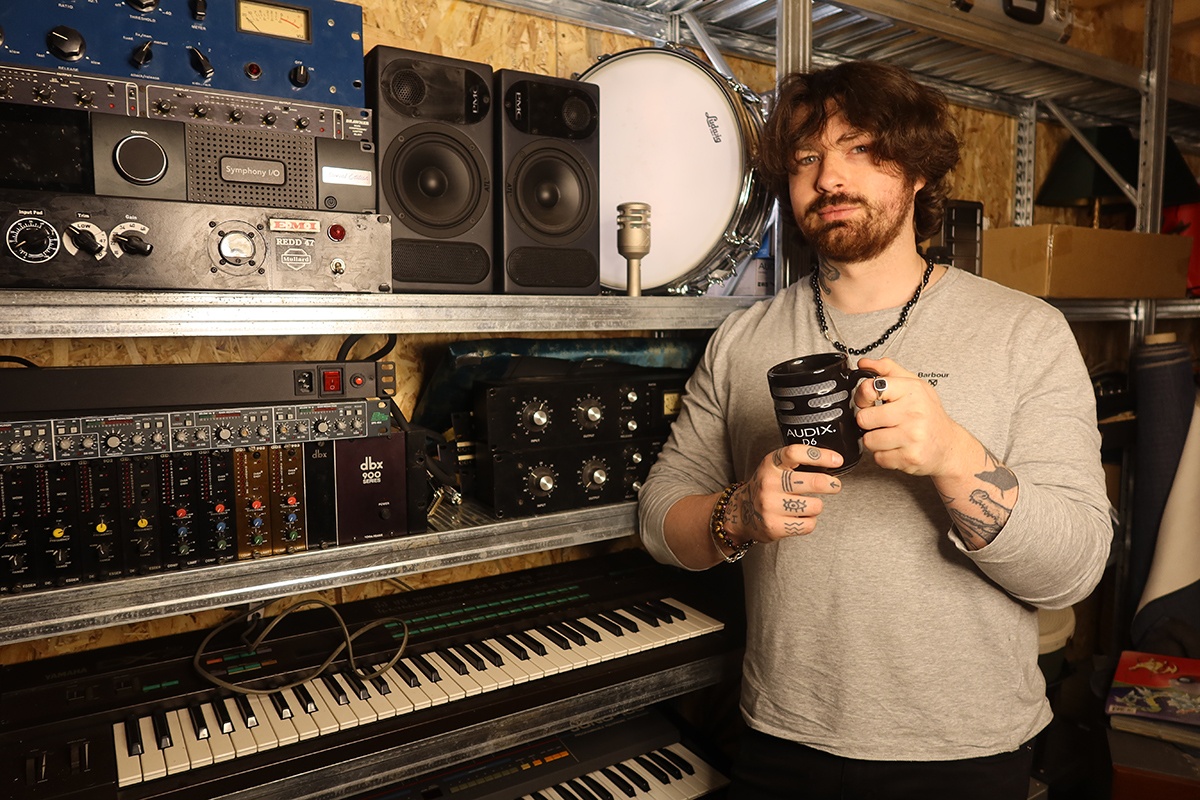
My first full drum mic set was one of the AUDIX Fusion series, the FP7 I believe. It included the F9 condensers, which are pencil mics that I still use to this day. At Catalyst Studios, I had a three-month internship with an accomplished producer called Sugarhouse. He always used a D6 as his kick drum mic and an i5 on the snare. So, when I started to get set up, I knew they were great, and not crazy money, either. Then I saw the Fusion series kit and thought it would be a very good jumping-off point. The D2 and D4 became my go-to tom mics. As my business started doing better, I started upgrading to your higher range of mics. I always request the D6 if I’m working in a commercial studio, because you put it in front of the kick, or a bass guitar cabinet, and it just works. I should have brought my D6 coffee mug for this Zoom call!
Which mics do you use as drum overheads?
The ones that look like a lollipop — the SCX25A. I don’t think they’re specifically sculpted for drums, but whether I have them in a standard overhead configuration or in X/Y, which I’ll sometimes do, they just sound right. The cymbals and snare cut really nicely in them, but they stay warm and don’t get too sharp or strident, which can happen with a lot of condensers as overheads. I was actually pleasantly surprised the first time I put them up there. They created a nice stereo picture of the kit with very little effort needed.
Have you tried the SCX25A on piano? People also like them for that.
You know, my production room in Camden is quite small. There’s a drum kit on one side and an upright piano on the other. So, I’ll often turn the drum overheads around and just put them on the piano. They have the same warmth in the treble range but pick up a lot of detail, like just the right amount of the fingers on the keys and the mechanical noises of the piano.
With AUDIX mics in general, how much EQ and/or dynamics processing do you find you need after the fact?
Not that I need it, but I’m pretty heavy on outboard no matter what I’m doing. It’s just how I like to work. For example, the D6 is amazingly sculpted for kick right out of the box, but I like to push things in that direction even further. If I’m at a place like Abbey Road, I’ll run it through a Neve 1084 preamp. With the SCX, I find all I ever do is brighten them up a little, and I can’t imagine I’d ever want compression on them because they already sound so even. I suppose what I’m saying is, yes, I do EQ quite a bit, but with AUDIX mics it’s to enhance what they’re already doing, not to compensate for what they’re not doing.
You also use the A133 on vocals, correct?
On vocals, yes, and I’ve been using it outside the kick drum in conjunction with the D6 inside. For vocals I find that what someone sings into the A133 is what I get out of it. It’s straightforward and truthful, and helps me instead of hindering me. It’s next to impossible to f*** up vocals with that mic, and next to impossible to botch recording any source with AUDIX in general!
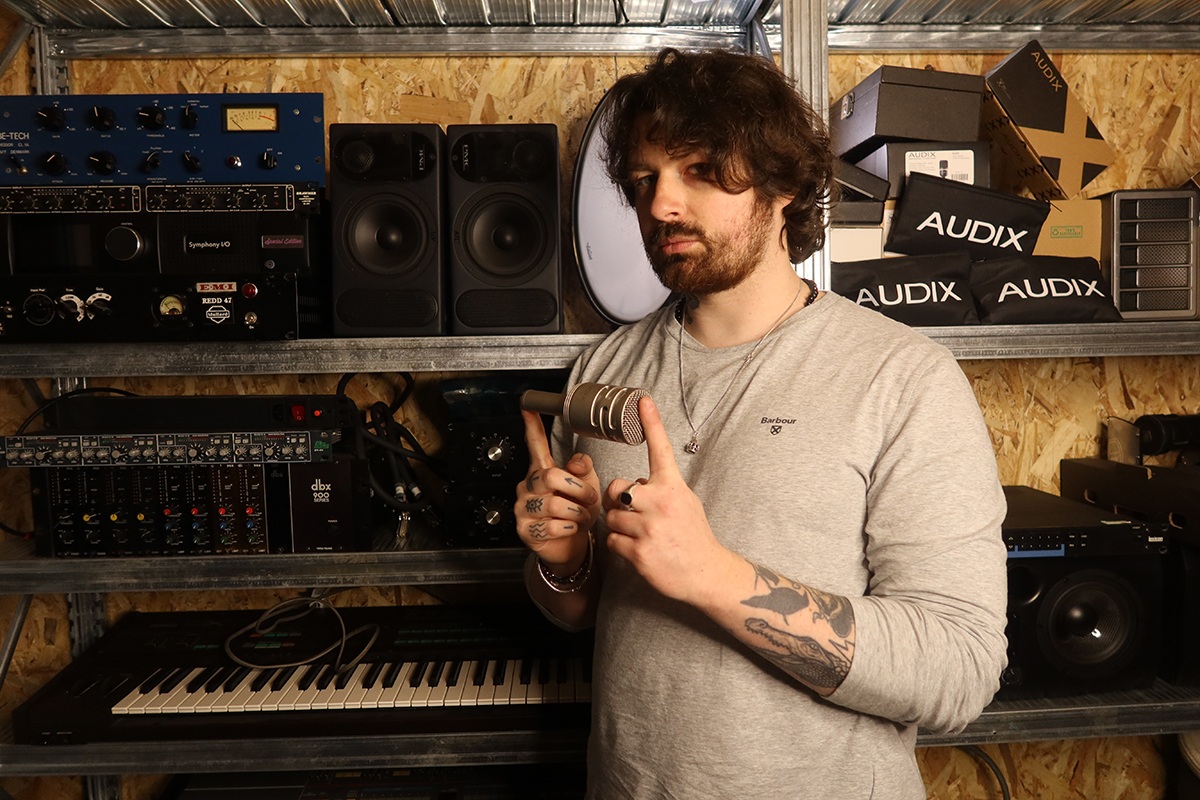
I know that you have also been using the new D6X. Can you tell us about that?
Sometimes, I’d need to swap mics or tweak settings to get the extra mids or tame an airy kick sound. But not anymore—now I just flip to the middle setting, and boom, all the mids I need are there. In my production room, I’m a “set-it-and-forget-it” kind of guy. Switching out mics used to kill my creative flow and slow down sessions, but now I can change the sound with a flick of a switch. I’ve also found that the D6X is way more usable on toms. Those extra filtering options really make a difference!
The bio on your website mentions you overcoming dyslexia. Would you be willing to share a few words about your journey?
You’re the first interviewer to ask about that, and yes, I would. It’s been a huge part of who I am because it was such an obstacle to work around. The worst part is, if I’m messaging or emailing with bands and misinterpret things. Or sometimes, someone will think I’m a scammer because my message has lots of spelling errors and so on. But I’m not at all shy about my dyslexia.
I think one way I’ve overcome it is that I’m a very visual learner. So, it hasn’t been an obstacle for learning how to use, say, a mixing console, which is laid out in a very orderly visual fashion. During my internship, I had to learn Pro Tools and had been accustomed to Logic, and I was able to learn all that visually without really reading the words on the screen.
But there’s something quite lovely about it, which is that when I’m in the music and in the act of producing and recording, I’m not overthinking things. Which I tend to do otherwise. There’s a government cyber-security agency in London that tends to hire dyslexic and neurodivergent people because our brains think things through differently and see different connections and patterns. Similarly, I don’t think I’d be the music producer I am if I weren’t dyslexic.
What advice would present-day you give to your younger self when you were just starting out in music?
I’d tell myself to beware of impostor syndrome. The first several times you get it, you want to quit. I’d tell myself to just keep going for it, because I’ve since learned that even some of the most talented people in the industry get it. I still do, sometimes quite badly. But I try to reframe it as wanting to improve. Not that I’m not any good, but that however much we achieve, the best mindset is that you’re forever a student and there’s always something new to learn. We’re all making up life as we go along. It’s like jazz.