“The OMX-E picked up nuances of my voice I had never heard in an amplified context before.”
It’s apt praise to call Australian-born singer-songwriter Leah Martin-Brown a breakout artist. But any surprise the term “breakout” implies is on us, because one listen is all it takes to know we should have been paying attention sooner. Her first band Lilly Rouge was creating a buzz in the early 2010s, with successor Evol Walks building a robust following soon after. Now a solo artist signed to Frontiers Records, Ms. Martin-Brown explores pop territory without sacrificing the hard-rock energy of her formative work. Her voice melts faces off, and the torches that channel its heat are microphones: the series (especially the ) onstage and the for studio recording. Just after hosting the video premiere of her third single “Shush,” she spoke with AUDIX about her musical roots and her new favorite microphones.
Can you share a favorite early memory of making music?
I’ve always really gravitated towards vocals and songwriting. I didn't know that I was a good singer until maybe fifth grade, when we had this assignment at school where each of us had to get up and sing. I sang the part, and my teacher reacted, “Oh, so you’re a singer?” I was, like, “I am? Why yes, I am!”
And the rest is history?
Then I got into choir and would write poems and try and sing to them. I had played the flute since early childhood, but that’s mostly not helpful for a singer-songwriter, so I first picked up a guitar when I was about 11. It took me about a year of learning before I wrote my first song on guitar — melody, lyrics, chords — and that continued all through high school.
Do you remember your first paying gigs?
I think I was maybe 14 and it was in the local music scene in the city of Gold Coast, Australia. I went to university for music and did a bachelor’s degree in popular music, then a post-grad in contemporary vocal performance at the Queensland Conservatorium. I toured around Australia from age 20 until about 22, then moved to the United States, where I formed my second band — I had one before that called Lilly Rouge. This new band was a hard rock project called Evol Walks, and it toured parts of the U.S. and Europe as well as Australia. During the pandemic, I moved to Stockholm, Sweden for a year, where I was given the opportunity to work as a solo artist, with songs that had been co-written and produced by Mutt Lange Tony Nilsson, and mix engineer Tommy Denander.
When you first performed in the U.S., what struck you as different?
I think I was spoiled, because my first performance in the States was at SIR Studios in Los Angeles. Beautiful soundstage, great equipment, I could hear myself well. That was a big shift from pubs and nightclubs. And whereas the people I had played with previously were phenomenal musicians, they had day jobs. These were career musicians, who did sessions and touring work all the time. It felt so cool to be working with them, because this is what I had wanted to do my entire life.
How did you first learn about AUDIX microphones?
I had always been aware of the brand, starting with knowing they made great drum mics. I hadn’t used any personally, but last year I got a call from [engineer and producer] Kevin Majorino, whom I’d met backstage at a show in Utah. He invited me to do some recordings at Studio 606, which is Dave Grohl’s private studio. We did an acoustic version of my second big single, “Hysterical Love.” So, of course I went, and for handheld vocal mics we were working with what is now called the OMX series. I remember thinking, “These sound insane!”
What did you like about the OMX-E mics?
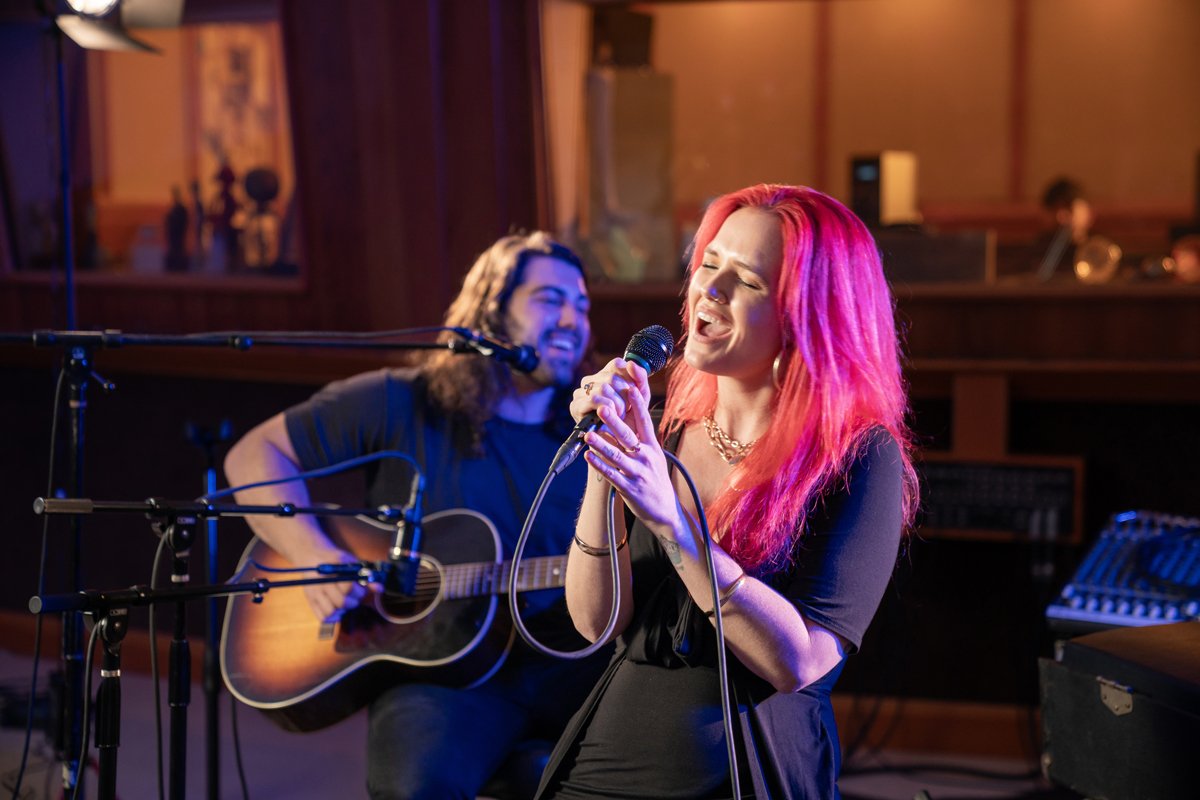
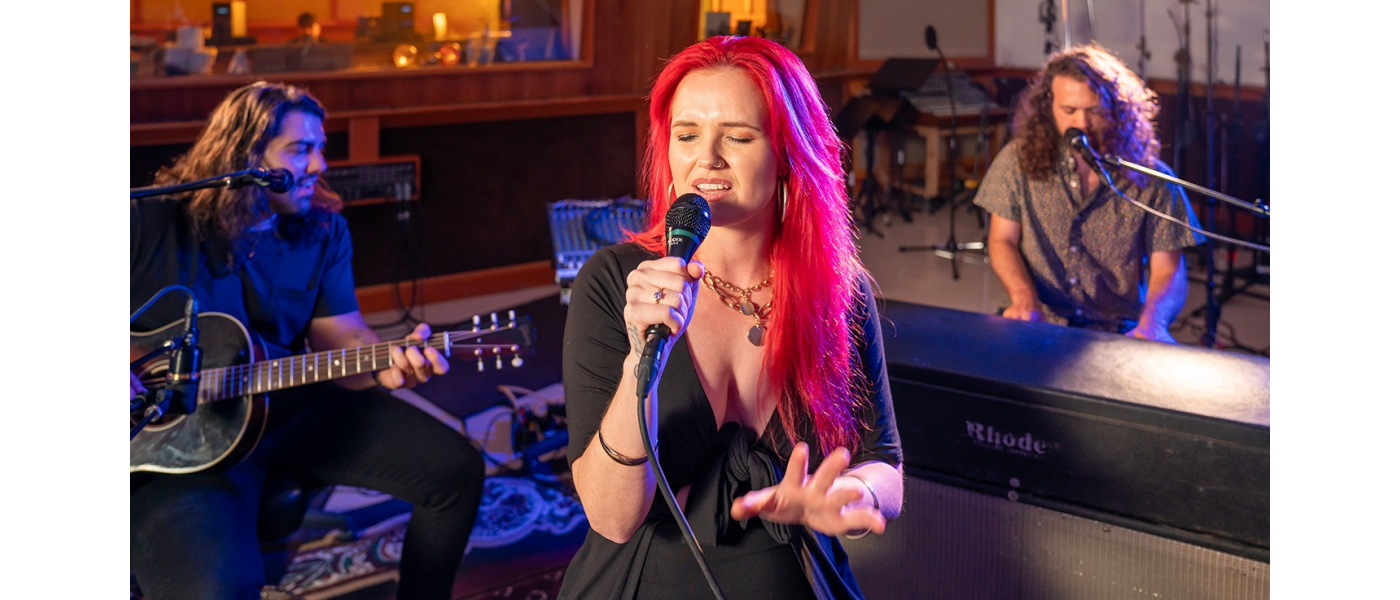
The OMX-E picked up nuances of my voice I had literally never heard in an amplified context before. It really captured the midrange as well as lower tones, making them very smooth and caramel-y. There was simply this depth. It didn’t make me sound harsh or strident, which some mics can do on my voice if they’re not mixed carefully. Since, I have also been using the OM5 and OM7, and just got a PDX720 (dynamic studio microphone) that I hope to be able to spend some time with soon.
With the OM and OMX-E series geared towards the stage, do you have a go-to vocal mic for the studio?
I have been using the A231 on all the covers and other songs I’ve done in the studio recently. I’ve previously used the German mic people most associate with studio vocals, but the A231 has been replacing it. It picks up so much detail and has such dynamic range. I can whisper into it, then back off and yell. It responds well to me changing my proximity as a performance technique. The real point is about the emotions. I find the A231 lets me capture any emotion in the booth, whatever the moment of the song demands. But to clarify, the OMX mics were first. They were the ones that turned me into an AUDIX user.
Tell us more about the AUDIX session at Studio 606.
We were in there for at least eight hours! We went through the acoustic version of “Hysterical Love” about a dozen times. It was me, the guitarist, and our keyboardist, and we did many different covers as well. It didn’t matter if we did something slow and lilting like “Rhiannon” by Fleetwood Mac or if we changed gears and I belted out AC/DC. When I was close on the OMX for softer passages it sounded full and rich, but lost
nothing at all if I pulled back. There was hardly any post-processing on it, EQ at the board, anything like that. In my opinion, anything like compression should be an added extra, not a corrective measure. It should match with the singer and support them. For me, that mic is the OMX.
Your own voice has incredible dynamic and emotional range. Who are some of your influences?
Bon Scott of AC/DC was definitely a big one when I was younger. Let’s see. Joan Jett, and I love Amy Lee of Evanescence — she has the most incredible voice. I really love Chris Cornell, whom is hands down one of the best singers I’ve ever heard. In terms of something super modern, I’d say Remington Leith from Palaye Royale has a very interesting tonal quality and charisma. I like Lizzie Hale. And of course, Janis Joplin.
Björk recently went on record calling Spotify the worst thing to happen to musicians. What is it like to earn a living as an artist in the age of streaming?
I have to say, I side with Lars Ulrich [Metallica drummer] on this issue. Did the internet create a downfall for musicians? Yes, but it happened in the heyday of Napster and LimeWire, when some consumers realized they could get everything for free. Once you cross that line, it’s hard to get anyone to want to pay for anything again. I think a lot of people don’t realize that artists spend a lot of money even to make home recordings — you need the computer, the audio interface, the DAW, the mics, and so on. I also see the consumer’s side. In the 1990s and before, everyone had the experience of buying an album because they liked a single. Then, the rest of the album didn’t sound like the single and we went, “What have I done?”
The truth is that today, being an artist is running a small business. You have opportunities to monetize your videos, you can create merchandise, you can tour, but all of this requires a baseline of startup revenue.
With that in mind, what advice would you give to your younger self when starting out, or to an artist who aspires to be like you now?
You have to trust yourself more than you trust anyone else. But also, have faith that some people you meet along the way really do want to help you, because they do. AUDIX certainly has. Believe in yourself, but you’re going to have to work really hard, because you don’t get a song on the charts or score a slot at a festival by sitting in your bedroom and believing. ##