
“Choosing the right mic for the right source is everything. That’s easy to do with AUDIX because they make so many different microphones geared to specific purposes and they all sound fantastic.”
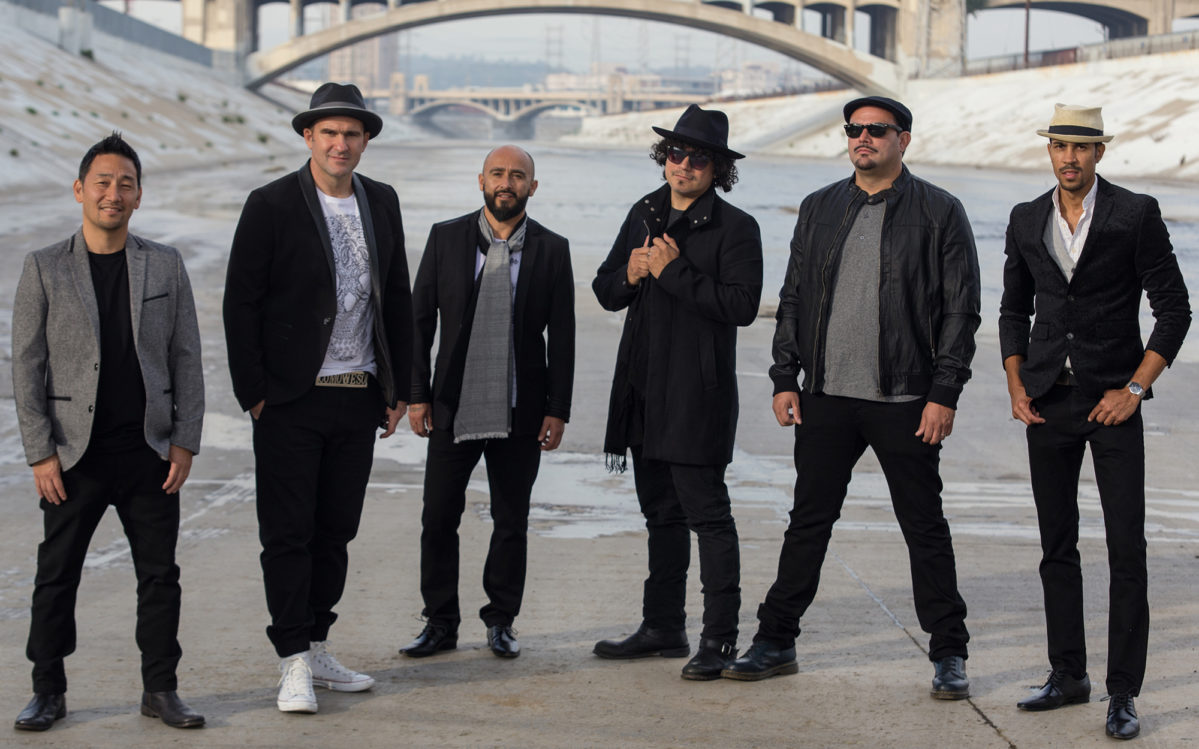
If one band is synonymous with the musical and cultural diversity that is Los Angeles, that band is Ozomatli. Since forming in 1995, the group has curated a globe-circling sound that effortlessly embraces salsa, funk, hip-hop, samba, cumbia, dancehall, New Orleans second line, reggaeton, Indian raga, and many other styles. They have even forayed successfully into children’s media with the book and accompanying track “Moose on the Loose” and album Ozomatli Presents Ozokids, not to mention their original score for the Happy Feet Two video game. Reiley Brinser does double duty as their tour manager and front-of-house engineer, relying on AUDIX microphones to mix the group’s blend of world percussion and conventional drum kit: the D6 on kick, D4 on toms, i5 on snare, MicroD on snare bottom, MicroHP on congas and bongos, D2 on timbales, SCX25A as drum overheads, and M1280B on assorted percussion.
How did you connect with Ozomatli and what was your pathway to becoming their front-of-house engineer?
I’ve been with the band now for about 12 years, and their full-time tour manager and FOH engineer for the last six. Before me, my brother Damon Vonn had that role. When he got the gig about 12 years ago, I was very lucky because he took me on. I started as a helper, gopher, driver, whatever they needed. In the middle of all that, I somehow held down a job at a local theater, and that’s where I got my audio chops up. I learned different consoles as different bands and musical theater productions would come and go. Eventually I got a call from my brother saying he was being promoted to the band’s manager and asking me if I would like to step up. Super scary, but it took me about two seconds to say yes. The guys in the band are super fun to be around, and there hasn’t been a dull moment since.
We understand you’re a musician yourself, too.
I’m a drummer. That’s where it all started. I grew up in Ventura County, California, where I still live today. I became part of the metal scene around here, and I band I was in called Burning at the Stake gained a pretty big following after playing a lot of successful shows in southern California. We put out our first EP around 2009. I took music theory classes in college then had to quit to go on tour and make money. But I never went to school for any of the audio engineering stuff. I was lucky my brother was in the industry, and I learned it all by doing.
We’ve seen Ozomatli live several times and the mix always sounds so transparent and detailed — like a recording but with live energy. Beyond your choice of microphones, is there a secret sauce?
A lot of people ask me that and my answer is always the same: It’s them. It’s the musicians. It’s the percussion. It’s their sense of dynamics. Of course, having great mics helps.
Tell us more about their sense of dynamics. Some bands have it innately and some leave it up to the engineer to create.
They certainly do. Okay, for example, Mario [Calire], our drummer, is one of the most dynamics-conscious drummers I’ve ever heard. That creates a sort of guiding atmosphere for the horn section, our percussionists Jiro Yamaguchi and Justin Poree, bass player Wil Abers, and the rest of the band. At the end of every show, the band performs a signature samba where they come out into the audience and get the whole crowd doing a drumline. Justin can get the crowd from screaming to everyone being quiet while some delicate part is being played, and that ethic applies to the whole band. It makes my job a lot easier.
Are drums and percussion the main application for your AUDIX mics?
Yeah, although I have experimented with the i5 on the guitar cabinet, with good results.

What are your main sources for the i5?
I have them on both the kit snare and the percussionist’s snare, and they never leave there. I like the top end of the i5; it doesn’t break up or get crinkly sounding. I also think it’s way more durable. Also, a little secret of our snare sound is that I use the MicroD on the bottoms of the snares. It really captures the snare wires themselves, has a great top end, and is just so easy to clip on.
Which mics are you using in other roles on the drum kit?
What’s the one everyone calls the lollipop? The SCX25A, that’s it. They’re incredible as drum overheads. I like to get the full picture of the kit as opposed to just spot-miking individual drums, and they’re great in that application. The drum kit and percussion are all AUDIX: overheads, toms, snares, and kick. I use the D6 on the kick drum, of course, and I also like it on the bass [guitar] cabinet. I was into the MicroHP on the toms as well, but I’ve come to prefer the tighter, more focused sound of the D4 for toms lately. The MicroHP are more open, and I find them ideal for congas and bongos.
Latin percussion, of course, is a huge part of Ozomatli’s sound. Can you tell us more about your setup there?
Sound-wise, the MicroHPs are night and day from anything I’ve ever used before — they pick up everything I want in those channels and nothing I don’t. The D2 is on timbales, right in between the shells.
One of my secret weapons is a little pencil mic called the M1280B. It’s not much bigger than stuff in the Micro series, and it’s a condenser. I use a pair of those to capture all the percussion toys: bells, cowbells, shakers, guiro, all that kind of thing. They just pick up everything perfectly. I originally got them for overheads at festivals because they could mount on extended clips, and we wouldn’t have to rely on festival stands. Plus, with at least seven musicians onstage and so many instruments, you’re barely going to get time for a decent line check at a big festival. So, we wanted to be as self-sufficient as possible — throw and go.
The SCX25A has since taken over as overheads, but I still keep a pair of the M1280B in my mic box for overheads when there’s a time crunch. But for the percussion toys, the 1280 with a little bit of reverb is just golden.
Given your drum-wide applications, what is your opinion of how AUDIX mics in general handle high SPL?
They take gain extremely well, especially the i5. But that’s true across the board with all of them. I haven’t had any issues. I’d like to point out that for me, a large part of that is getting the mic placement perfect for the source. If I do that, they’re able to hold anything we’ve thrown at them so far, in a very sonically pleasing way.
A fully miked drum kit has a lot of mics close together, so how do you deal with rejecting mic bleed?
Again, placement is key. But let me tell you, I haven’t found anything like the i5 when it comes to getting the snare but not getting toms or anything else I don’t want in the picture. It’s true that our drummer Mario has everything quite close together, but with all of the clip-on mounting stuff AUDIX has, like the Dvice, we’re able to keep the placement very consistent from one show to another.
Fewer mic stand footprints onstage can’t be a bad thing either.
Absolutely. There’s less clutter to step around and it just looks cleaner, too.
What’s the most challenging thing about mixing Ozomatli and how do you approach it?
All the percussion in addition to a traditional drum kit and balancing that with the vocals and horns — bringing things in and out when they need to be. When a venue or rental company is just throwing whatever dynamic mics they have at the situation, this is very challenging with a band like Ozomatli. Now that we carry all of our own AUDIX mics, I can really think about why I’m using a particular mic on a particular source, how I’m placing that mic, why might I change something up if Mario picks a certain snare for a certain gig, things like that. I’m finally feeling like I can get mixes to translate very easily from one venue to the next.
Has the mic complement saved you any time in terms of, say, needing to apply EQ and compression after the fact?
Oh, yes. Choosing the right mic for the right source is everything. That’s easy to do with AUDIX because they make so many different microphones geared to specific purposes and they all sound fantastic. Second most important is placement. Now that I’ve worked all that out, I find that I’m needing very little EQ or compression after the fact. I’m cutting very little top end on anything, especially the sources miked with the i5. I’m doing the standard high-pass rumble filtering across the board and notching out the occasional problem frequency, but that’s it.
What advice would you give to your younger self?
Do what you love, don’t quit, and you’ll end up doing this forever. Don’t worry about getting better. That will happen if you simply keep doing it. I’ve gotten to learn from some pretty amazing people who really know their stuff — the guys in Ozomatli and other folks, too. The common denominator always is that they’ve done it forever, and they love it, you know. And everyone does it a little differently. That’s what makes it fun.