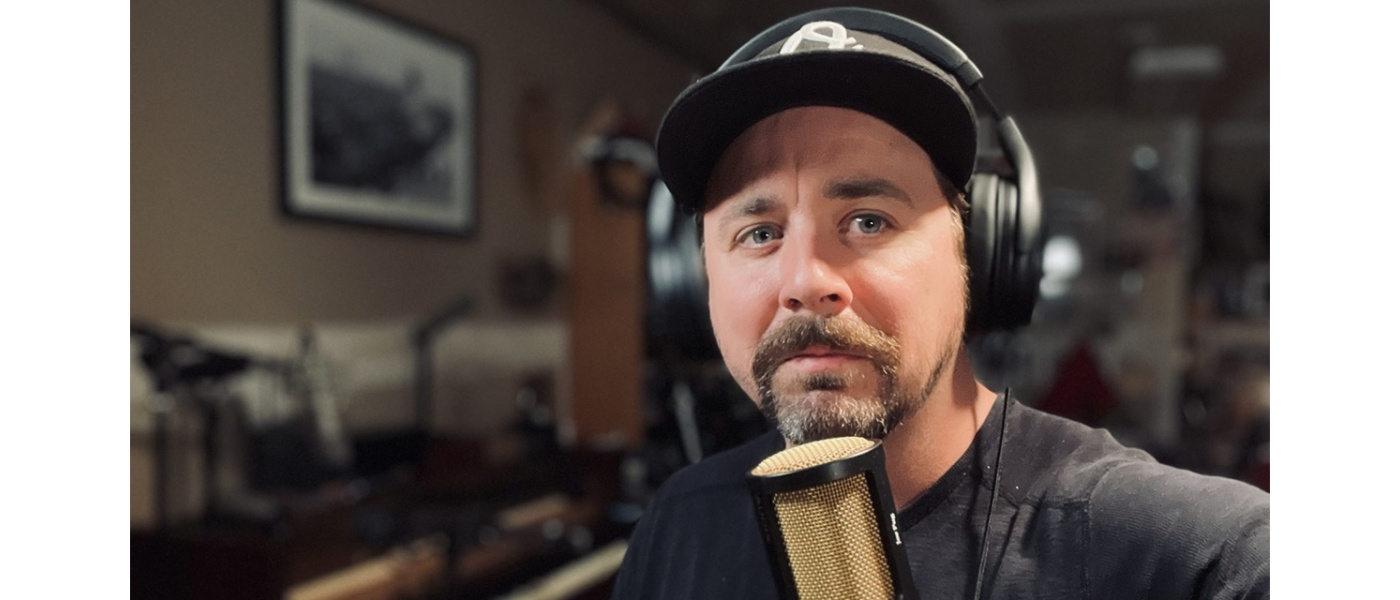
I won’t name names, but there’s a certain mic you see in front of a lot of podcasters and radio DJs. For me, the PDX720 is going to be the killer of that mic, or maybe the new Cadillac version
Joe Pug is the quintessence of the American singer-songwriter. His lyrics have drawn comparisons to such literary giants as John Steinbeck, Raymond Carver, and Walt Whitman, and his story could well set up a great American novel: disillusioned with college, working in his father’s profession of carpentry, picking up a guitar, and eventually, his music bending the ear of country-rock superstar Steve Earle. Today, he tours and records on his own terms for a devoted fanbase and hosts the podcast The Working Songwriter. Recently, he discovered that the PDX720 dynamic studio vocal mic from AUDIX is as versatile as he is, producing stellar results on voices both sung and spoken. He spoke with AUDIX about his brilliant career, not to mention his use of the PDX720, an OM5 handheld vocal mic onstage, and A150 headphones in the studio.
What was your point of entry into music as a young person?
I dropped out of college at about 21. I moved to Chicago, where I was working as a carpenter’s helper. At night, there was a robust open mic scene. You’d get the alt-weekly newspaper, The Chicago Reader, and it listed all the open mic events. So, I guess it was the natural progression — first the open mics, then getting Monday night opening gigs at local clubs, to headlining on a Monday night, then opening for bigger artists on other nights, and so on.
Was there a “big break” moment in all of this?
Yes, the one that let me quit pounding nails. I was the local opener for a Texas-based songwriter named Rhett Miller when he came to town. Rhett passed along my original demo to none other than Steve Earle. Steve really liked it and straight-up invited me to come out on the road with him. That was my entrée into playing music for a living. Steve gave me a total master class in being a performing songwriter. Then the gigs just started coming, and other than during the pandemic, they’ve kept coming.
Was there a musical childhood behind all this?
My dad played in bands all the time until he had me, which I get — I have three kids now. Anyway, my dad was the first to teach me guitar, and I had played in a few bands. I had been going to college to become a playwright. The problem with theater, though, is it takes a lot of people and money to do it right. There are entire permission structures you go through to get something produced. With music, it could just be me rolling up to an open mic with my $200 acoustic guitar and getting something started. Music ended up being my creative outlet because it could be so self-reliant.
Other than Steve Earle, who are your musical heroes and influences?
I was 12 years old when Nirvana hit. That was a cultural juggernaut in my life. When I was ten, my aunt introduced me to John Prine, who has been a sort of north star to me ever since. My high school girlfriend, who is now my wife, gave me Tom Waits’ Closing Time when we were 16. The other artist who’s been a fixture the whole time is Gillian Welch.
How do you balance your current project with parenthood?
I used to do these eight-week tours before I had kids. Now I try to tour like a stand-up comedian. I tell my agent, “I want to leave the house on Wednesday and be home by Sunday afternoon.” If you look at the tour dates on my website, it looks like one big tour, but in reality, I go out a couple of times a month for a few dates. I was just in Rhode Island and New Hampshire, and am about to be in Park City, Utah. We hit the West Coast in the fall.
How many musicians do you tour with?
I used to tour with such large bands. Now, it’s either just me doing a storytelling type of show, or I travel with an upright bass player. He has a bluegrass background and sings with me. Touring with a band is expensive these days, so I try to keep it to a lean singer-songwriter format in terms of both people and equipment.
What was your first encounter with an AUDIX mic, and in what context?
In fact, it’s this new PDX720. For my higher-end work in the studio, I had always liked a certain German brand, which is about as predictable as saying you like Martin guitars. Then I spoke to an AUDIX rep and decided to give the PDX720 a try. I have been pretty blown away by it. I checked out the company and thought, “Oh, this makes sense,” because they actually do their research and development in-house. The manufacturing is right here in the States, in Oregon. I’ve been pretty impressed.
What applications have you found for the PDX720 so far?
Right now, both for a new record I’m making and for my weekly podcast, The Working Songwriter. As the name implies, I interview other singer-songwriters about the process and challenges of making music in this format.
It’s interesting that the PDX is your first Audix. A lot of artists tell us it’s a drum or instrument mic. But we don’t mind being known for great mics for every source …
Not just mics! Recently I’ve been getting into your high-end headphones, the A150. What’s great about them is how well baffled and padded they are around my ears. I can be working on a vocal with the cue mix just cranked up, and none of it bleeds out, even if, say, a sensitive large-diaphragm condenser mic is right nearby. But my main experience has been the PDX and the OM5 live vocal mic.
What do you like about the PDX720 in particular?
I won’t name names, but there’s a certain mic you see in front of a lot of podcasters and radio DJs. It’s rumored that artists like Tom Petty and Michael Jackson cut all or most of their vocals with it. For me, the PDX720 is going to be the killer of that mic, or maybe the new Cadillac version.
Feature-wise, the PDX720 is very durable, clear, and balanced. On the back, there’s a presence boost that lets you hype the midrange just perfectly. For a podcast with spoken dialogue, I don’t want that, but if I need a vocal to cut through a mix on a song, flicking this switch adds either 1.5dB or 3dB of boost, which saves me a lot of time EQ’ing after the fact. It cleans up my workflow.
The PDX is meant for studio vocals, but it’s dynamic, which is unusual right away. What difference does that make for you, good or bad?
It works perfectly in this world of project studios that are a step or two above what we might call bedroom studios. I’ve got some good stuff at home, but my room is not perfectly treated and soundproofed, because I don’t happen to have $35,000 laying around just for that. Large-diaphragm condensers are great for professional studios, but they are so sensitive that they pick up everything — that’s the point, really. So, I’d better not cut vocals in October, which is leaf blower season here in Maryland! The PDX720 is sensitive enough to pick up all the detail of a singer who’s right up on it, but it almost magically ignores unwanted ambient noises from the outside world.
So, the killer app of the PDX is sort of a Goldilocks amount of rejection?
I’d describe the killer app like this. If you’re a rock star, or a weekend warrior who’s also a lawyer, maybe you have a perfectly treated space. The rest of us working musicians want to make great material in spaces that more ad hoc. DAW software, plug-ins, audio interfaces, and the like have been up to that task for quite a few years now — and a lot of them do it very affordably. But when it comes to mics, most have been either too low-end or too high-end and sensitive. The PDX hits the sweet spot exactly. It just works.
Have you tried it on sources other than vocals?
No, but spoken word for podcast and sung studio vocals are quite different applications, both because of the sonic characteristics of the source and the intended goal of the production. It’s hard for dynamic mics to pick up a vocal performance that cuts through a band but is also your go-to for broadcast. The PDX does it with clarity, and again, that hardware midrange boost helps a lot.
Do you find the same is true of the OM5?
Yes, but interestingly, where the PDX responds more like a live dynamic mic in that you can almost put your lips right on it with no problems, the OM is more like a studio condenser. It sounds best if you back off it a bit, but still has great rejection of other instruments you don’t want bleeding into it. It’s sort of the opposite of what you’d expect. But I continue to reach for the OM5 for my live gigs.
It’s one thing to be a mega pop star, but it’s arguably more sustainable to be a working musician with steady gigs and time for family. What advice would you give to help people make a living doing music?
My dad, who I told you played in bands, was a carpenter by trade. When I first told him I wanted to do music for a living, he immediately replied, “Keep it skinny.” In other words, keep your costs low. That has been a huge benefit to me. Every time I pick up extraneous costs related to touring or making a record, it comes back to bite me. All it takes is one or two months of not being able to punch a paycheck, and you may have to quit and find other work.
My advice, which is more on the technical side, is to spread your art across as many mediums as possible. Use every vector to reach your audience. Of course, you should be on YouTube, Instagram, and Facebook. Of course, you should have your music on Bandcamp. But yes, you should also do a vinyl record. Yes, you should appear on as many podcasts as you can. Yes, you should put together an interesting email newsletter for your fans. Heck, talk to a microphone company if they want to interview you!
It’s not enough anymore to put out a record every 18 months or two years. Spreading your work out across all mediums maximizes the chances of holding people’s attention and paying enough dividends to keep you in the game.