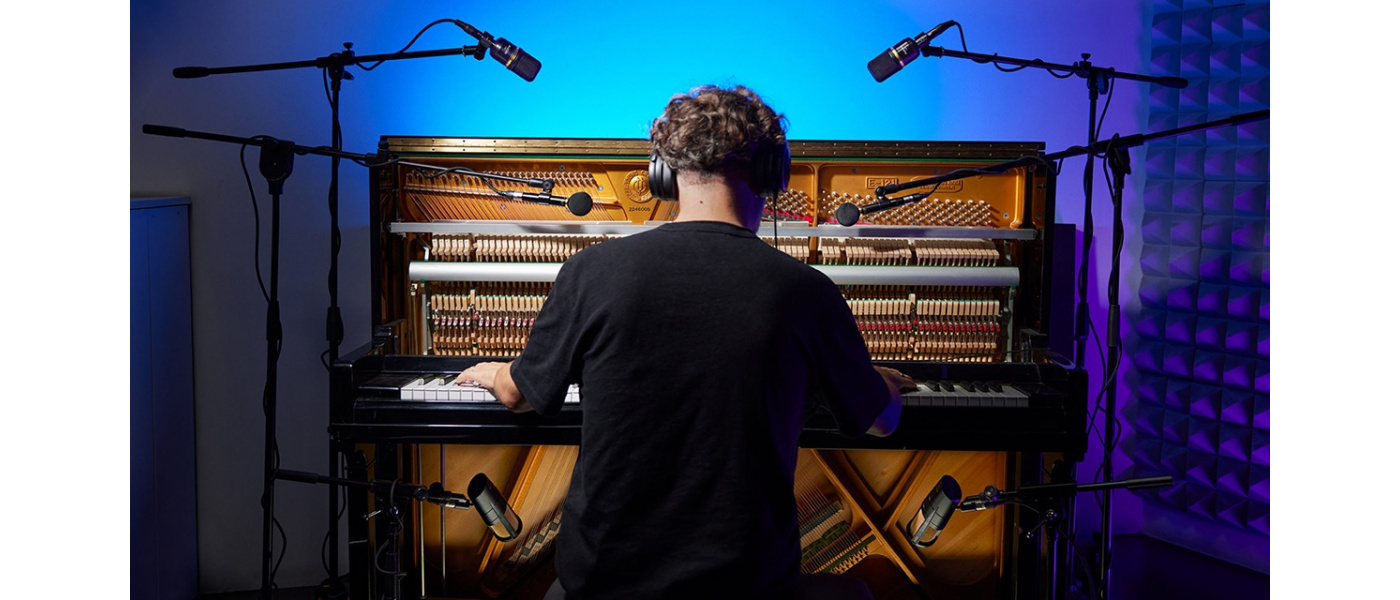
AUDIX mics were vital in capturing the main sound of my piano and recreating the main stage for our work”
Andrea Manzoni is an Italian-born pianist and composer extraordinaire, known for his music for film and theater and performances around the world. Manzoni recently collaborated with renowned score composer and producer Giorgio Ferrero at his MyBossWas Studio in Turin, Italy on a groundbreaking recording entitled Self-Portrait. Due to the unique and unconventional nature of the recording, a tour-de-force of the uncharted sonic possibilities of the piano, Manzoni and Ferrero called upon an array of AUDIX microphones for their highly sensitive and detailed reproduction, specifically the SCX25APS, SCX1, A231, PDX720, and ADX60.
While Manzoni and Ferrero have known each other for years, as their first true collaboration, Self-Portrait marks an unlikely pairing. In the last decade, Manzoni’s career included performances at Carnegie Hall in New York, solo and trio tours, and contributions to Michele Bravi’s latest release, along with touring across Italy with artists like Andrea Bocelli. On the other hand, Ferrero, with a background in indie-rock and extensive experience in score composition and audio-visual installations for top-notch museums worldwide, is also recognized for his directorial work on the award-winning film Beautiful Things, along with commercial work for brands like Nike and Alpha Romeo.
Despite their busy schedules, Manzoni and Ferrero shared insights into their collaboration, highlighting the significance of AUDIX microphones in capturing the essence of their work.
What brought you together for Self-Portrait and can you tell us about the title?
Andrea Manzoni: We’ve known each other for years, and I’ve even done some work for Giorgio at MyBossWas, but we’ve never collaborated like we did on Self-Portrait, which was much more substantive.
Giorgio Ferrero: Indeed, our diverse musical backgrounds was intriguing from the start, but the inspiration for Self-Portrait came when I needed a pianist to perform some crazy, odd things for a project that I was working on during the pandemic and Andrea for a performance at the Teatro Regio in Turin. Inspired by the potential suggested by this experience, Andrea suggested that we lock ourselves in my studio for two or three days to see what we would discover.
Manzoni: And what was amazing was that the things that we found were ourselves.
Ferrero: You’re jumping ahead! In the first three hours we were together, we had the first draft of the piece that was destined to become the title for the album. As we were listening back to our scratch tracks, we found ourselves deeply talking about our lives. We realized that the dissonances and distortions we were hearing reflected what was currently going on in our lives…and then we knew that we were creating a “Self Portrait.”
Very interesting! Can you share details about the work’s creation?
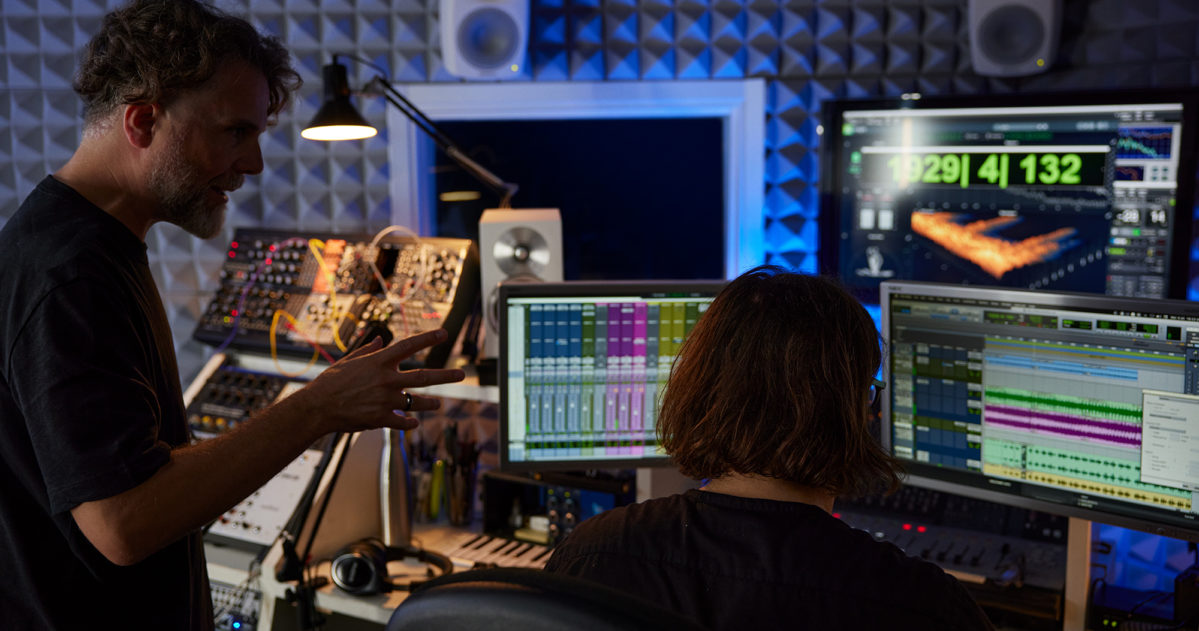
Ferrero: Yes, I knew that to capture the dynamic feel of reality that we were going for, I needed to create an appropriate technical setup that would allow me to do in real time what I would usually do in post-production. I decided to use the DAW (digital audio workstation) as if it were a live instrument. As we captured Andrea’s playing, we began looping different things in parallel, mangling and interacting with sounds on the fly.
Manzoni: It all started musically from a riff. In an instant, Giorgio told me to make it odd time, so I removed a note, and it started looping in a syncopated way.
Ferrero: Then I distorted the whole thing!
How exciting. Can you tell us specifically how you captured the performance with AUDIX microphones?
Ferrero: We used my upright piano, which while a rather common instrument, I’m very lucky to have because it sounds and plays well. I knew we were going to mistreat it and wanted to capture a range of tones, so I set up the AUDIX microphones to give us sources that could be extremely malleable and extremely diverse that I could manipulate with processing.
I set up three pairs in A/B configuration:
- Above the piano I placed a pair of AUDIX A231s, which were heavily processed with my outboard tube gear to give them a rich, lo-fi retro low-fi, sound.
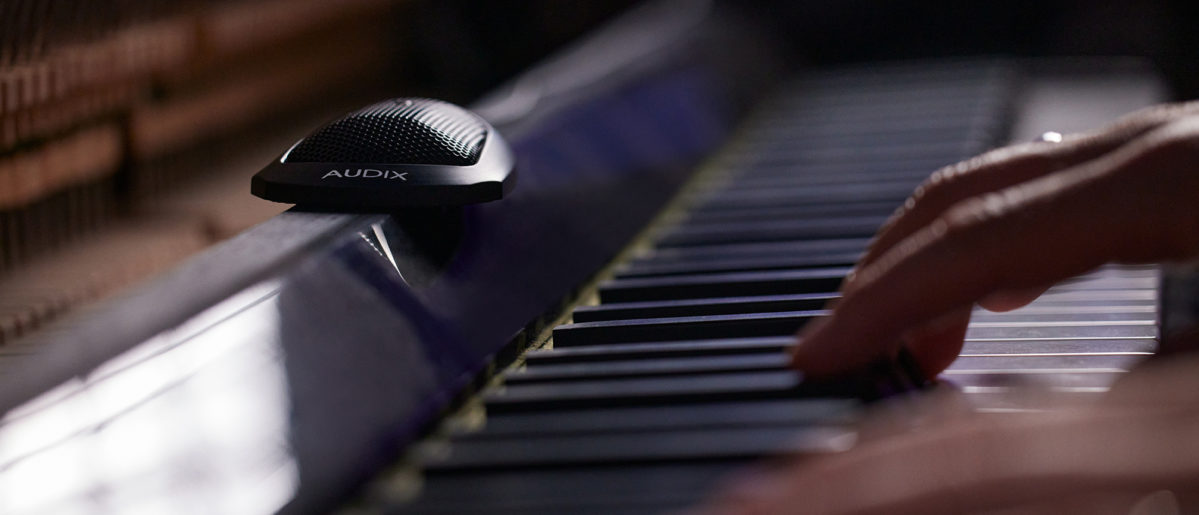
- I placed a matched pair of SCX25s in front of the piano felts near the sound board knowing that it would be one of the key sounds in our work.
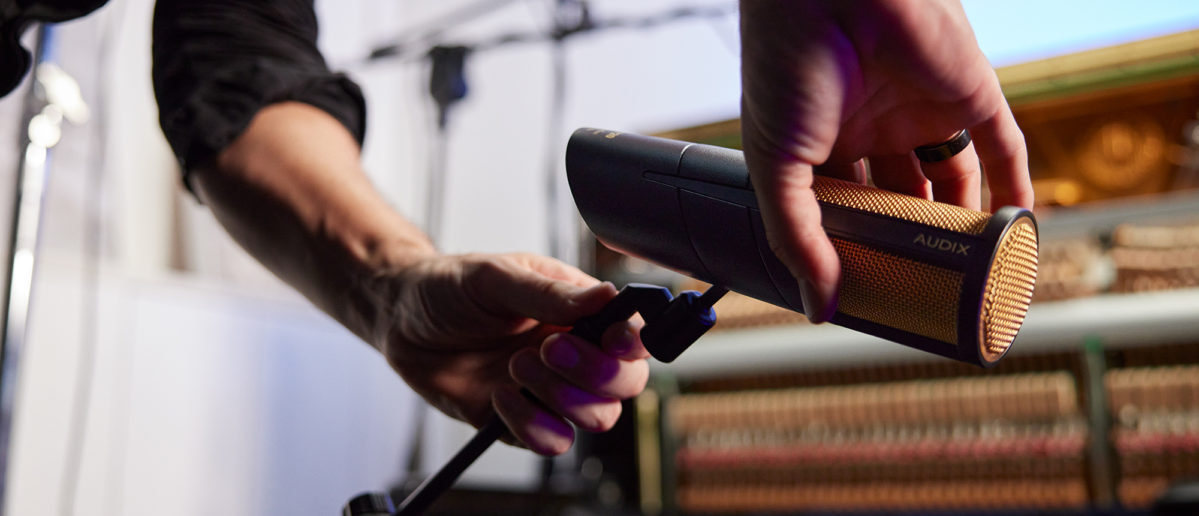
- Then I added the two wonderful PDX720 microphones, underneath, next to Andrea’s feet. These mics were used for the percussive parts because they have great “podcast“ dynamics, and they were heavily compressed.
The PDX720s were very useful to our sonic goals. Because of their position they did not have much definition, yet they still captured nice, nasty mid-rangey things and transients from the strings.
How did you incorporate the ADX60 and SCX1?
Ferrero: The AUDIX ADX60 is a mic that I always use in my theatre productions. In this scenario I used it in mono, wired with a long cable, so that it could be placed almost anywhere, as a mono source mainly for triggering things. Primarily, I placed it in the center of the piano as a mono low-fi trigger and then I moved it around based on what Andrea did on the piano. For example, it became a source for a pair of analog filter banks that I used to create a counter arpeggiating sound. The ADX60 enabled us to enter the beloved world of sound synthesis, but all sourced from acoustic events triggered on the piano.
Manzoni: We also did this beautiful thing with a pair of SCX1 placed outside of the room that had the piano, to create this feeling of having the listener start by hearing the distant ambient sound of the piano, then gradually come into the room, and then step into the piano itself.
So you used different AUDIX microphones to provide different sonic layers and to guide the listener through different acoustic spaces?
Manzoni: Yes, we took the listeners from outside the room into the piano, manipulating sounds in real time to evolve the piece. Counterpoints, freeze environments, and heavy processing transformed the piano’s sound, expressing a range of emotions.
Ferrero: When the listener’s head is inside the piano a world of emotion through sounds opens up. After a few seconds, we begin processing and manipulating sounds in real time. Some processing created counterpoints to Andrea’s arpeggios by inserting alien notes that he didn’t play. Then there are a series of “freeze environments” made with real time DSP that begin to take the piano from our room into another space, into another world, entirely. Then, we made it all evolve until a heavily filtered piano sound arrives and it expresses our gut feelings—our anger and rage spreads across the sound field.
Manzoni: In my opinion, we managed to do something extremely interesting… so much so, that this is the beginning of a record and a performance that we plan to work on during next year. We both realized that this collaboration had an extremely powerful outcome and that, if left to our own devices, neither of us would have created anything like this.
Ferrero: The project will also sport a visual counterpart capable of describing this very concrete, molecular, and rough approach of ours.
Can you talk about the ending of the piece?
Ferrero: Ah, yes. That’s the point where Andrea and I are really mistreating the piano and creating a percussive groove. I could only do this because it’s my piano, otherwise they’d charge us for damages. [laughs] I used a wire brush, a drum brush stick, on the strings while Andrea was playing to create a very naughty rhythmic loop, where the kick sound is made by hitting the Sordino pedal while the Sustain pedal was held down. We are so proud of this sound in particular and it was only made possible because the AUDIX PDX720s pair really shone and allowed us to capture these sounds with such detail. I firmly believe that AUDIX microphones helped the piece become a truly interesting crossover with electronic minimalism where everything was made on or with the piano!
Manzoni: We took an Einstürzende Neubauten approach, which I like because the sound generation comes from that violence, and it clearly lends itself to being performative because a lot of things happen between, hands, kicks and punches.
The piece starts in a very romantic way and you may think it will end well, but instead in the end, you figuratively smash your head through glass and against a sheet of metal.
How was it, for the two of you, working together?
Manzoni: Despite our different musical backgrounds and approaches to creativity, our shared humanity brought us together.
Ferrero: We have differences in approach, but we are similar in that we both pass through very neurotic creative phases then calm down afterwards. This allowed us to create things we wouldn’t have done individually and ensured a smooth workflow without disrupting each other’s processes, while simultaneously avoiding artistic boredom or disagreements.
Among the AUDIX microphones used, which stand out in your experience?
Ferrero: I really liked the PDX720s. I am used to working with other dynamic microphones in these scenarios, in fact they are some of the microphones I use the most, but the PDX720 surprised me because they provide more level. What I mean by that on something like this project, where I was actively manipulating things on the fly, I didn’t have to ride the gain too much or rely too much on preamp gain at all.
Another thing I like about the PDX720 is that it features a lot of detail on the mid-highs, which in this case is what was needed and the transients were really helpful. I was very surprised and can imagine using them for processing concrete music or percussion with little signal and with low dynamics because they are loud with a low noise floor.
Then ADX60 is also a wonder of a mic. I can tape it anywhere and it helps so much in finding great spots to source interesting sounds for our musical ideas.
Last but not least, the matched pair of SCX25s was vital in capturing the main sound of my piano and recreating the main stage for our work.